

Table of Contents
- Why Surprise Plumbing Fees Happen (and How to Spot Them Early)
- The Pre-Service Fee Checklist: What to Ask Before You Book
- Questions to Ask a Plumber Before Hiring (and Why Each One Matters)
- How to Get a Written Plumbing Estimate Before Work Begins
- How to Compare Plumbing Quotes Fairly (Without Getting Fooled by Low Bids)
- Warranties, Callbacks, and Workmanship Guarantees: What to Confirm
- Your Rights and Dispute Steps When a Plumbing Bill Exceeds the Estimate
- Frequently Asked Questions
Why Surprise Plumbing Fees Happen (and How to Spot Them Early)
Learning how to avoid surprise plumbing fees starts with understanding where they come from. Most unexpected charges trace back to unclear pricing before the job starts, not to dishonest work.
At Lake Michigan Heating, Cooling, Plumbing, we’ve seen how confusion over billing practices creates distrust. A homeowner gets a low estimate over the phone, then a much bigger bill arrives. The gap usually comes from fees that were never explained.
Here’s what most guides get wrong: they blame the plumber. In reality, the problem is a missing conversation. Ask three questions before anyone touches a pipe:
- What is the service call fee?
- Is there a separate diagnostic fee?
- What does your hourly rate or flat-rate pricing cover?
Get answers in writing. That single habit prevents most disputes.
The Pre-Service Fee Checklist: What to Ask Before You Book
A pre-service fee checklist is the fastest way to prevent unexpected fees. Run through it every time you call a new plumber, even for a small repair. The goal is to convert vague promises into specific numbers you can compare across companies.
Before booking, confirm these items and write down the answer for each:
- Dispatch fee: the charge just to send a technician.
- Diagnostic fee: what it costs to find the problem.
- Trip fee: whether travel to your home adds cost.
- After-hours fee: the premium for nights, weekends, or holidays.
- Labor charge: hourly rate or flat-rate pricing.
- Parts and materials: marked up, or billed at cost plus a percentage. Ask for the markup policy in writing.
- Permit fee: who pays it and whether it’s included.
- Additional charges: what triggers them and who approves them. You should approve any change before the work continues.
Write down each answer. Then compare quotes using the same list. A quote that omits a line is not cheaper, it is incomplete.
Dispatch, Diagnostic, Trip, and After-Hours Charges Explained
A dispatch fee is the base cost of sending a plumber to your address. A diagnostic fee covers the time spent finding the problem. A trip fee is a travel charge, and an after-hours fee is the extra cost for emergency repair outside normal hours.
Some companies bundle these. Others list them separately. Neither approach is wrong, but you deserve to know which one you’re paying for. Ask directly: “Is the diagnostic fee credited toward the repair if I hire you?” Many companies apply it, and some don’t.
What These Fees Look Like on a Real Invoice
A transparent invoice separates every charge. Here is a simplified sample of what a well-itemized bill looks like for a mid-complexity repair, such as replacing a kitchen faucet and repairing a shutoff valve:
|
Line item |
Description |
Amount |
|---|---|---|
|
Service call / dispatch |
Base visit charge |
$89 |
|
Diagnostic |
Locate leak and assess valve |
$125 (credited toward repair) |
|
Labor |
2.0 hours at flat-rate pricing |
$340 |
|
Parts |
Faucet, supply lines, shutoff valve |
$180 |
|
Permit |
Not required for this repair |
$0 |
|
Tax |
Sales tax on parts |
$12 |
|
Total |
$746 |
Notice what the invoice does not do: it does not lump everything into one number, and it does not add a trip fee after the fact. If your invoice arrives as a single line, ask for the itemized version before you pay.
Questions to Ask a Plumber Before Hiring (and Why Each One Matters)
The right questions to ask a plumber before hiring protect your wallet and your home. Each one exposes a different hidden cost or risk.
Ask these questions in order:
- Are you licensed and insured? Ask for proof. A licensed plumber carries state credentials and liability coverage.
- Will I get a written estimate before work begins? Verbal quotes leave you exposed.
- What’s your warranty on parts and labor? Confirm callbacks and workmanship guarantees.
- Do you charge for the estimate itself? Some do, some don’t. Know before you book.
- Who approves additional charges? You should be asked, not told after the fact.
- Can you explain the price breakdown line by line? A clear itemized invoice should follow.
If a company dodges any of these, treat it as a warning sign. Honest answers take seconds. Evasion costs you later.
How to Get a Written Plumbing Estimate Before Work Begins
A written plumbing estimate is the single best defense against a surprise bill. It converts a vague promise into a document you can hold a company to.
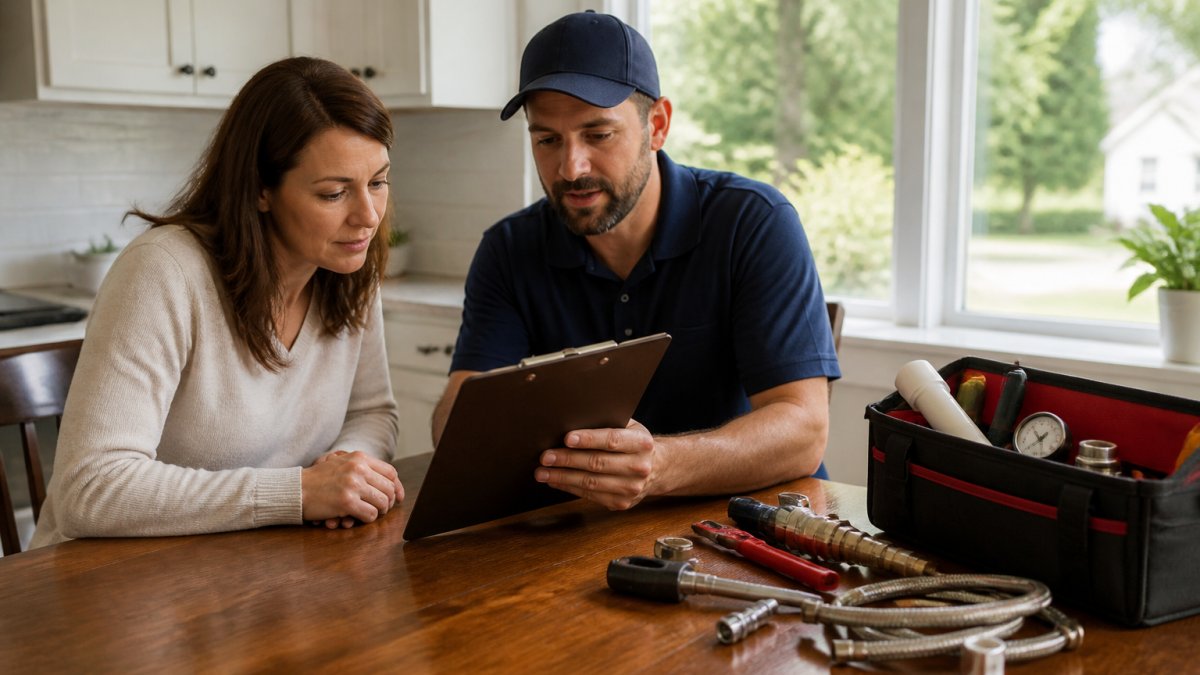
Request the estimate in writing before any work starts. A phone quote is not enough. In practice, the estimate should arrive by email or on paper, with a clear scope of work.
What a Complete Written Estimate Should Include
A complete estimate covers more than a total price. Check that it lists:
- The full scope of work in plain language
- Parts and materials with brands or specs
- Labor charge, whether hourly rate or flat-rate pricing
- Any permit fee and who files it
- The service call fee and diagnostic fee
- A stated validity period for the quoted price
- Terms for additional charges and who approves them
If any line is missing, ask for it in writing. An estimate without a scope is just a number. A number without terms is how surprise fees begin.
How to Compare Plumbing Quotes Fairly (Without Getting Fooled by Low Bids)
Comparing plumbing quotes fairly means comparing scope, not just totals. The lowest bid often wins the job and loses the homeowner money.
Here’s the trap. One quote says “replace the water heater: $X.” Another says “replace water heater, including permit, expansion tank, new shutoff valve, and haul-away: $Y.” The second looks higher.
Use this comparison method:
|
What to Compare |
Why It Matters |
|---|---|
|
Scope of work |
Same job, or hidden extras later? |
|
Fee structure |
Flat-rate pricing vs. hourly rate changes the total |
|
Parts quality |
Cheaper parts can mean repeat repairs |
|
Warranty terms |
Longer coverage protects your wallet |
|
Permit handling |
Unpermitted work can fail inspection |
Get at least two written estimates. Then compare line by line, not bottom line to bottom line. A low estimate that omits permit fees or materials isn’t cheaper. It’s just incomplete.
Warranties, Callbacks, and Workmanship Guarantees: What to Confirm
Warranty terms decide who pays when a repair fails. Confirm them before you sign anything, not after the problem returns.
Ask three things. First, how long does the workmanship guarantee last? Second, does the warranty cover both parts and labor?
A common mistake is assuming the manufacturer’s warranty covers installation. It usually doesn’t.
Also confirm the process for a callback. You shouldn’t pay a second service call fee for a problem the company was supposed to fix.
Your Rights and Dispute Steps When a Plumbing Bill Exceeds the Estimate
When a plumbing bill exceeds the estimate, you have options. Acting calmly and in order protects your position. Most competitors stop at “ask for an itemized bill”, this section walks through the full dispute process, including license verification and consumer-protection channels.
A legitimate bill can rise above the estimate if the scope changed. A new problem found mid-job, or a part that cost more than expected, can justify additional charges. The key is customer approval. A company should ask before doing extra work, not bill you after.
Step 1: Request an Itemized Invoice in Writing
Ask by email, not just by phone. An email creates a timestamped record. Request that every charge appear as a separate line: dispatch, diagnostic, labor hours, parts, permits, and tax. If the company refuses to itemize, that refusal itself is worth documenting.
Step 2: Compare the Invoice to Your Written Estimate
Place the two documents side by side. Note each difference and label it: in scope, out of scope but approved, or out of scope and not approved. Only the third category is a true dispute.
Step 3: Request a Written Explanation for Unapproved Charges
Ask the company to explain, in writing, any charge that was not in the original scope and that you did not approve. Give them a reasonable deadline, five business days is common, and keep the response.
Step 4: Verify the Plumber’s License and Insurance
Before or during a dispute, confirm the company is actually licensed. Most states maintain a searchable licensing board database. Search the company name and the individual technician’s license number. You can also ask for a certificate of insurance showing general liability and workers’ compensation coverage.
Step 5: Put Your Dispute in Writing and Escalate
Send a written dispute to the company by email or certified mail. State the facts, the amount in dispute, and what resolution you want. If the company does not respond, escalate in this order:
- State licensing board. File a complaint against the license. Boards can investigate and discipline contractors.
- State attorney general’s consumer protection office. Many states regulate home service contracts and offer a formal complaint process.
- Better Business Bureau. Not a regulator, but a public record that some companies respond to.
- Small claims court. For amounts within your state’s limit, this is often the fastest path to a judgment.
The Federal Trade Commission’s guidance on deceptive pricing explains what counts as a misleading charge. Your state attorney general’s office can also review billing practices that feel unfair. Keep copies of every estimate, invoice, and message.
Unexpected plumbing fees rarely come from nowhere. They come from missing questions, verbal quotes, and estimates without a scope. Fix those three gaps and you control the bill before work begins.
At Lake Michigan Heating, Cooling, Plumbing, we explain every charge upfront. Our fully insured and certified team provides clear communication and honest answers, with recommendations based on what’s best for your home and budget.
Schedule Service with Lake Michigan Heating, Cooling, Plumbing and get a clear, written estimate before any work starts.
Frequently Asked Questions
How can I avoid surprise plumbing fees?
Ask for a written plumbing estimate before any work starts. Confirm the service call fee, diagnostic fee, trip fee, and after-hours fee upfront. Get the estimate itemized with labor, parts, and permit costs separated. Ask whether the price is flat-rate or hourly, and get the plumber’s policy on additional charges in writing. If the scope changes mid-job, the plumber should stop and get your approval before continuing.
What should a plumbing estimate include?
A complete written plumbing estimate should list the service call fee, diagnostic fee, labor charge (hourly rate or flat-rate pricing), parts and materials, permit fee if applicable, and any additional charges for after-hours or emergency repair. It should also state whether the quote is binding or an estimate, the expected timeline, and warranty terms. Ask for an itemized invoice format so you can compare quotes fairly.
Can a plumber charge more than the original estimate?
Yes, but only if the scope of work changes and you approve the additional charges first. Reputable plumbers will stop when they discover unexpected issues, such as hidden water damage or corroded pipes, and present revised pricing before continuing. If a plumber completes extra work without your approval, you have grounds to dispute the bill. Always ask about the process for handling mid-job changes before work begins.
What should I do if a plumbing repair costs more than expected?
First, request an itemized invoice showing every charge. Compare it to your written estimate and note any discrepancies. If charges were added without your approval, contact the plumbing company in writing and ask for an explanation. If you cannot resolve it directly, you can file a complaint with your state’s consumer protection office or the Better Business Bureau. Keep all documentation, including texts, emails, and the original estimate.