

Table of Contents
- 24/7 Emergency Furnace Repair in Kent County
- Common Furnace Problems and Solutions
- Emergency HVAC Service Cost: What to Expect
- When to Replace vs Repair Furnace
- Safety Protocols for Gas Leaks and Carbon Monoxide
- DIY Troubleshooting Checklist Before You Call
- Frequently Asked Questions
Last Updated: September 23, 2026
24/7 Emergency Furnace Repair in Kent County
Emergency furnace repair in Kent County is the process of getting a failed heating system diagnosed and fixed outside normal business hours, usually within hours rather than days. When a furnace quits on a January night, the difference between a warm house and a frozen one comes down to who answers the phone. At Lake Michigan Heating, Cooling, Plumbing, our certified technicians handle these calls across the region, and we've learned that most homeowners wait too long before reaching out.
The urgency is real. According to Local 4 News reporting on HVAC industry trends, roughly 70% of recent repair jobs for one HVAC specialist were classified as emergencies, a jump driven by extreme temperature swings. After-hours emergency dispatch fees in the area typically run $200 to $450 before any parts or labor. That's the price of waiting until the house is cold.
Below, we'll walk through the problems that cause most failures, what emergency service actually costs, and when a repair stops making sense.
Common Furnace Problems and Solutions
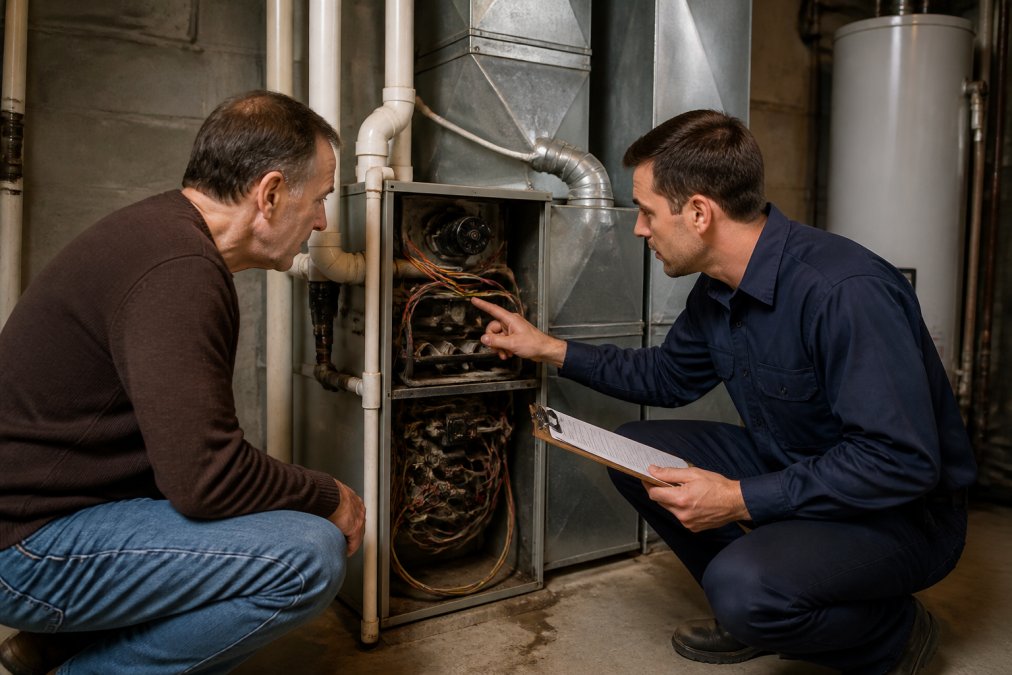
Most furnace failures trace back to a short list of culprits. Knowing which one you're dealing with helps you describe the problem accurately when you call, which speeds up the repair.
Thermostat and Pilot Light Issues
The thermostat is the cheapest thing to check and the most common false alarm. Dead batteries, a tripped breaker at the panel, or a thermostat set to "cool" instead of "heat" account for a surprising share of no-heat calls. Before anything else, confirm the thermostat has power and is calling for heat.
Pilot light and ignition problems come next. Older standing-pilot furnaces can lose their flame from a draft or a dirty orifice. Modern furnaces use electronic ignition, and a failed igniter or flame sensor will shut the system down as a safety measure. Neither is a homeowner fix.
Blower Motor and Heat Exchanger Failures
A blower motor that hums but doesn't spin usually means a failed capacitor or a seized bearing. The furnace fires, but no air moves, so the house stays cold and the unit overheats.
Heat exchanger failures are the serious ones. A cracked heat exchanger can leak carbon monoxide into your living space, which makes this a safety issue, not just a comfort one. Any technician who finds a crack should red-tag the furnace immediately.
Emergency HVAC Service Cost: What to Expect
Emergency HVAC service cost breaks into three parts: the dispatch or after-hours fee, the diagnostic charge, and the parts and labor for the actual fix. The dispatch fee is the one you'll see quoted upfront, and in this region it can vary. The diagnostic charge can vary on top of that, and it is frequently credited toward the repair if you approve the work.
What separates an emergency rate from a standard rate is not the repair itself, it's the timing and the labor premium. A common pattern in the trade is that the same blower motor replacement costs one price at 2 p.m. on a Tuesday and a higher price at 2 a.m. on a holiday, because the after-hours labor rate and the dispatch fee both apply. The parts cost does not change. If a provider quotes you a wildly different parts price at night than during the day, that's a red flag, not a premium. Understanding these labor premiums becomes even more critical when the age of your equipment forces a decision between repair vs replacement to avoid recurring emergency service calls.
Here's what actually moves the number up or down:
- Time of day: weekends, holidays, and overnight calls carry the highest dispatch and labor premiums
- Season: the first deep freeze of the year floods dispatchers with calls, and demand pricing can appear
- Part availability: a blower motor on a common model is often stocked on the truck; an exotic control board may need an overnight order, which adds a second trip
- System age: older units take longer to diagnose and source parts for, and seized fasteners add labor time
- Access: a furnace in a finished basement or a tight closet takes longer to service than one in an open utility room
A transparent provider will tell you the dispatch fee, the diagnostic fee, and the likely range for common repairs before a truck rolls.
One more thing most guides skip: ask whether the company offers financing or a service plan. A maintenance plan often waives the dispatch fee or discounts the diagnostic charge, which can pay for itself in a single emergency. And if cost is the barrier, ask about assistance programs before you go without heat, more on that below.
When to Replace vs Repair Furnace
Here's how to think it through:
| Situation | Recommended Action | Why |
|---|---|---|
| Repair under 50% of unit value, unit under 10 years old | Repair | You keep a system with years left |
| Repair over 50% of unit value | Replace | Money goes toward a new system instead |
| Unit over 15 years old with repeated failures | Replace | Reliability drops, efficiency falls |
| Cracked heat exchanger | Replace | Safety issue, not repairable |
| Single failed component, young system | Repair | Cheapest path to heat tonight |
| Two or more repairs in the same heating season | Lean replace | The failures are becoming a pattern |
Three factors the table can't capture:
Repair frequency. One breakdown in five years is bad luck. Three breakdowns in two winters is a system telling you something. Each emergency call carries a dispatch fee, a diagnostic charge, and the disruption of a cold house, and those costs add up faster than the sticker price of a new unit.
The honest answer is that a good technician will tell you when a repair is the right call, even when a replacement would pay them more. That's the standard we hold at Lake Michigan Heating, Cooling, Plumbing, and it's why we explain the math before recommending anything.
Safety Protocols for Gas Leaks and Carbon Monoxide
Gas leaks and carbon monoxide are the two emergencies that outrank a cold house. If you smell rotten eggs or your CO detector sounds, get everyone outside and call 911 or your gas utility from a neighbor's phone. Do not flip switches, do not light anything, and do not re-enter to open windows.
A few non-negotiables:
- Never run a gas furnace with a known heat exchanger crack
- Keep the furnace area clear of stored items and flammable material
- Have the system inspected annually, especially before the first cold snap
- If the CO alarm sounds, treat it as real every time
DIY Troubleshooting Checklist Before You Call
- Confirm the thermostat is set to "heat" and above room temperature
- Replace thermostat batteries and check the display
- Check the furnace breaker at the electrical panel and reset if tripped
- Confirm the gas valve to the furnace is open
- Check the furnace power switch (looks like a light switch near the unit)
- Replace a dirty air filter; a clogged filter can trigger a shutdown
- Check the condensate drain line on high-efficiency units for a blockage
- Note any error codes on the control board or LED blink pattern
- Listen for the blower and watch for the igniter glow
If none of that restores heat, it's time to call. Programs like Home Repair Services of Kent County provide furnace repair and replacement help for eligible homeowners, and the county's rehabilitation assistance uses federal Community Development Block Grant and HOME funds to keep heating systems safe, according to Kent County Government. If cost is the barrier, ask about assistance before you go without heat.
Frequently Asked Questions
How much does an emergency furnace repair cost in Kent County?
After-hours emergency dispatch fees in Kent County can vary. The total cost depends on the specific repair needed, parts required, and time of day. For a firm estimate upfront, contact a licensed HVAC contractor directly. Lake Michigan Heating, Cooling, Plumbing provides transparent pricing before any work begins, so you can avoid surprise charges.
What should I do while waiting for emergency furnace repair?
First, if you smell gas, leave the home immediately and call 911 from a safe location. If there is no gas odor, turn off the furnace at the thermostat and switch, and use space heaters with caution, keeping them away from flammable materials. Do not attempt to relight the pilot or open the furnace panel. Keep children and pets warm with blankets, and watch for signs of carbon monoxide like headache or dizziness. A professional technician will arrive as quickly as possible.
What is the HVAC $5,000 rule for furnace replacement?
The $5,000 rule is a guideline some HVAC professionals use: if the cost of a repair multiplied by the age of your furnace exceeds a certain threshold, replacement may be more cost-effective. However, this is not a hard rule. A trusted technician will evaluate your system's condition, efficiency, and your budget before recommending repair or replacement.
Are 24/7 HVAC services available throughout Kent County?
Yes, many HVAC contractors in Kent County offer 24/7 emergency services, including nights, weekends, and holidays. Availability can vary by provider, so it is best to call ahead and confirm. Lake Michigan Heating, Cooling, Plumbing provides around-the-clock emergency furnace repair for homeowners across the region. When you call, you will speak with a real person who can dispatch a licensed technician promptly.