

Table of Contents
- Decode the Noise: What Your Boiler Is Telling You
- How to Bleed Radiators and Clear Air Pockets
- Boiler Pressure Gauge Reading: Adjusting for Quiet Operation
- Kettling, Limescale, and Debris: When a System Flush Helps
- Loose Components, Vibration, and the Circulating Pump
- When to Call Us for a Noisy Boiler
- DIY Safety Checklist and Smart Thermostat Fixes
- Conclusion: Quiet Comfort Starts with the Right Fix
- Frequently Asked Questions
Decode the Noise: What Your Boiler Is Telling You
A noisy boiler is rarely just an annoyance. According to ASME’s analysis of steam boiler availability and maintenance cycles, how you handle failure and repair data directly shapes how long heating equipment lasts. That banging, whistling, or gurgling sound is your system reporting a problem in the only language it has.
This guide walks you through how to fix a noisy boiler, from bleeding radiators to knowing when to stop and call a pro.
Most homeowners wait too long. They hear a clank, shrug it off, and turn up the thermostat. That delay is what turns a cheap fix into a costly repair.
Here’s the good news: you can diagnose most noises yourself in under an hour. Below, we’ll show you exactly how to match each sound to its cause, with a safety-first checklist so you never risk a gas appliance.
The five most common boiler noises, and what each one means:
- Banging or hammering: trapped air or kettling
- Whistling: restricted water flow or high pressure
- Gurgling: air pockets or low water
- Humming or vibration: loose parts or a failing pump
- Clicking: ignition or thermostat issues
How to Bleed Radiators and Clear Air Pockets
Bleeding radiators is the fastest fix for a noisy boiler, and it takes about 15 minutes. Air trapped in your central heating system creates the banging and gurgling you hear. Releasing that air restores quiet operation.
Here’s how to bleed your radiators:
- Turn off the heating and let the system cool for 30 minutes.
- Find the bleed valve at the top of each radiator.
- Hold a cloth and a small container under the valve.
- Turn the valve key counterclockwise a quarter turn.
- Wait for the hiss of escaping air to stop, then close the valve.
- Check your boiler pressure gauge and top up if it dropped.
Start with the radiators on the lowest floor and work upward. Air rises, so this order pushes trapped pockets out efficiently.
Boiler Pressure Gauge Reading: Adjusting for Quiet Operation
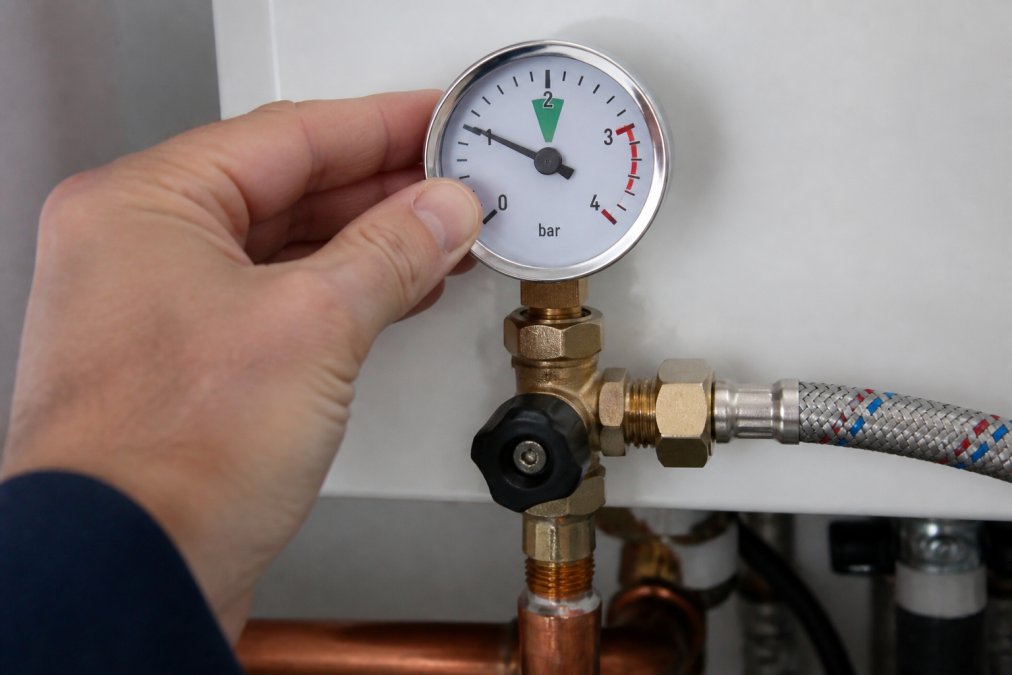
Your boiler pressure gauge reading should sit between 1.0 and 1.5 bar when the system is cold. Pressure outside that range is one of the most common causes of a noisy boiler, especially whistling sounds.
Low pressure usually means a leak or trapped air. High pressure points to overfilling or a failing expansion vessel. Both make your system work harder and louder.
To adjust pressure:
- Locate the filling loop under the boiler.
- Open the valve slowly and watch the gauge.
- Stop at 1.2 bar for a cold system.
- Close both valves firmly when done.
If pressure climbs back above 2.0 bar within a day, stop refilling. That points to a faulty pressure relief valve or expansion vessel, which needs a professional.
Kettling, Limescale, and Debris: When a System Flush Helps
Kettling sounds like a kettle boiling on the stove, and it comes from the heat exchanger. Here’s the mechanism: hard water carries dissolved calcium and magnesium. When that water sits against a hot metal surface, those minerals precipitate out and form scale. Scale insulates the metal, so the water trapped against it overheats and flashes to steam. Those steam bubbles collapse violently, and that collapse is the rumbling you hear.
The key variable is water hardness. The harder your water, the faster scale accumulates and the sooner kettling starts. If you have a water softener, your boiler scales far more slowly than a neighbor’s on the same street without one. That single fact explains why two identical boilers can fail years apart.
A system flush clears the deposits.
Signs you need a flush:
- Rumbling that grows louder over weeks
- Cold spots at the bottom of radiators (sludge settles there)
- Discolored or black water when you bleed a radiator
- A magnetic filter that fills up fast
- Radiators that heat unevenly room to room
A flush is a job for a heating engineer, not a DIY task. It requires a pump, chemical handling, and a way to dispose of the effluent properly. Attempting it yourself risks chemical burns, water damage, and a system left worse off than before.
One preventive note: a magnetic system filter installed on the return pipe catches iron sludge before it reaches the heat exchanger. It won’t stop scale from hard water, but it slows the debris side of the problem and makes future flushes cheaper.
Loose Components, Vibration, and the Circulating Pump
Vibration and humming usually trace back to loose components or a failing circulating pump. The hard part isn’t the fix, it’s finding which one. Here’s how to isolate the source before you touch anything.
Use a screwdriver as a stethoscope. Press the handle of a long screwdriver against your ear and the tip against a suspect component, the pump housing, a pipe clip, the casing panel. Sound travels through the metal and tells you exactly where the noise originates. This is the single most useful trick for a noisy boiler, and it costs nothing. Move the tip along the pipework until the hum gets loudest; that’s your source.
Isolate the pump. The circulating pump sits beside the boiler, not inside the sealed combustion unit, so it’s often the real culprit even when the noise seems to come from the boiler itself. Put your hand flat on the pump housing. If you feel a strong, irregular vibration that matches the sound, the pump is the source. If the housing is quiet but the boiler casing rattles, the problem is elsewhere.
Check the pump speed setting. Many circulators have a three-speed selector on the body. A pump set too high pushes water through the system faster than the pipework can handle quietly, creating a rushing or humming noise. Dropping it one speed often silences the system with no loss of heat. If the pump is already on its lowest setting and still noisy, the issue is mechanical, not hydraulic.
Tighten the obvious offenders. Loose panels, pipe clips, and pump mounts rattle against the casing. A wrench and a few minutes often solve it. Check the casing screws first, they work loose over years of thermal cycling.
When to Call Us for a Noisy Boiler
Call an HVAC professional when noise comes with gas smells, error codes, or pressure that won’t hold. Those signs point to combustion or mechanical failures that DIY repairs can’t safely fix.
Stop and call for help if you notice:
- A rotten egg or gas smell
- Yellow instead of blue flame
- Repeated pressure loss
- Water pooling around the unit
- Error codes or lockouts
DIY Safety Checklist and Smart Thermostat Fixes
Run this checklist before any DIY work, and check your smart thermostat settings too. A thermostat that cycles the boiler too often can cause noise on its own.
DIY safety checklist:
- Shut off power and gas before opening any panel
- Let the system cool fully
- Never touch gas lines or the combustion chamber
- Keep a carbon monoxide alarm nearby
- Stop if you smell gas and leave the building
- Call a pro for anything inside the sealed unit
Smart thermostat fixes:
- Lower the cycle rate in the app settings
- Check that the thermostat matches your boiler type
- Update firmware to fix odd cycling behavior
- Confirm the schedule isn’t short-cycling the system
Conclusion: Quiet Comfort Starts with the Right Fix
A noisy boiler is a signal, not a life sentence. Match the sound to the cause, run the safety checklist, and fix what you can safely handle. For everything inside the sealed unit, or any noise tied to gas, pressure loss, or error codes, bring in a certified expert.
Frequently Asked Questions
What should I do if my boiler is making a loud banging noise?
A banging noise often points to air pockets or a faulty circulator pump. Start by bleeding your radiators to release trapped air. Check the boiler pressure gauge reading; if it is below 1 bar or above 2.5 bar, adjust the fill valve. If the banging continues, turn off the system and call a professional. Ignoring it can damage the heat exchanger and lead to costly repairs.
Is a noisy boiler a fire risk?
A noisy boiler is not automatically a fire risk, but unusual sounds like popping, rumbling, or a whistling sound can signal overheating, a faulty pump, or a blocked flue. These conditions can become dangerous if left unchecked. If you smell gas or see soot, leave the house and call 911. For persistent noises, schedule a boiler service with a licensed technician to rule out safety hazards.
How can I make my boiler less noisy without calling a technician?
You can reduce noise by bleeding radiators to remove air pockets, checking the boiler pressure gauge reading and topping up to the recommended level, and tightening any loose brackets or panels. If you hear kettling, a system flush may help remove limescale and debris. However, if the noise persists after these steps, it is best to call a professional for a diagnostic.
When should I be concerned about boiler sounds?
Be concerned if the noise is new, getting louder, or accompanied by a drop in heating performance. Sounds like banging, kettling, or a whistling sound that do not improve after bleeding radiators and checking pressure often indicate mechanical failure. Call an HVAC professional if you hear grinding, screeching, or if the boiler repeatedly shuts down. Delaying service can lead to higher repair costs.