

Table of Contents
- HVAC Repair vs System Replacement: The Core Decision
- The 50% Rule and $5,000 Rule: Financial Frameworks for 2026
- Repair Costs vs Average HVAC Replacement Cost in 2026
- Signs Your HVAC Needs Replacing: 7 Warning Signals
- HVAC System Lifespan: How Long Should Your Unit Last?
- Long-Term ROI, Financing, and Tax Incentives
- Maintenance History and Smart Home Integration
- Frequently Asked Questions
HVAC Repair vs System Replacement: The Core Decision
Industry projections estimate HVAC system replacements will reach 3.5 million units in 2026, driven largely by systems installed in the mid-2000s reaching the end of their service life, according to BDR's 2026 industry forecast. That wave of failing equipment is why the hvac repair vs system replacement question matters more this year than it has in a decade. At Lake Michigan Heating, Cooling, Plumbing, we walk homeowners through this decision, and the honest answer depends less on the calendar than on what a repair actually buys you. This guide breaks down the two financial frameworks technicians use, the warning signs that point toward replacement, and the financing options most articles skip.
HVAC repair vs system replacement is the decision between fixing a failing component on your current unit or installing a new system entirely. The right call depends on equipment age, repair cost relative to replacement cost, breakdown history, and how long you plan to stay in the home.
The stakes are real: a 2026 survey found that 79% of homeowners expect to repair or replace at least one major home system within the year, per Contracting Business's Housecall Pro survey coverage. The 5 frameworks below show you exactly how to decide without guesswork.
The 50% Rule and $5,000 Rule: Financial Frameworks for 2026
Two industry guidelines do most of the heavy lifting here. The 50% Rule says replacement is the better investment if a repair costs more than half the price of a new system, according to Pro House Maintenance's 2026 HVAC statistics guide. The $5,000 Rule, popularized by Lennox, multiplies your system's age by the repair cost. If that number exceeds $5,000, replacement deserves serious consideration.
| Framework | How It Works | Replace If | Best For |
|---|---|---|---|
| 50% Rule | Compare repair quote to new system price | Repair exceeds 50% of replacement | Single large repair decisions |
| $5,000 Rule | Age × repair cost | Result exceeds $5,000 | Older systems with recurring issues |
| Breakdown frequency | Count service calls per year | 2+ calls in 12 months | Chronic reliability problems |
| Energy bill trend | Compare year-over-year utility costs | Bills climbing without rate changes | Efficiency-driven replacements |
Neither rule is gospel. A 12-year-old furnace needing a $1,800 blower motor computes to $21,600 under the $5,000 Rule, which overshoots. What most guides miss is that these frameworks are conversation starters, not verdicts. Use them alongside the physical inspection.
Repair Costs vs Average HVAC Replacement Cost in 2026
The average HVAC repair in 2026 runs between $415 and $1,200, while a full system replacement ranges from $2,500 to $8,000 depending on system type and complexity, per WebFX's HVAC marketing statistics. That gap is smaller than many homeowners assume, which is why repair-versus-replace math often surprises people.
But sticker price is the wrong number to compare. The right number is total cost of ownership over the years you plan to stay in the home. Here is how to build it.
Step 1: Project repair spending on the old unit. Take your last two years of service invoices and average them. If you paid $600 last year and $900 the year before, budget roughly $750 per year going forward, and expect that number to climb as components age. A common pattern is that repair spending roughly doubles in the final three years of a system's life.
Step 2: Project operating cost on the old unit. Pull twelve months of utility bills and isolate the heating and cooling portion (many utilities show this breakdown in your online account). Multiply by the number of years you plan to stay. Add a 3-5% annual escalation for the efficiency loss typical of aging equipment.
Step 3: Project operating cost on a new unit. A higher-SEER or higher-AFUE system uses measurably less energy for the same comfort. Your contractor can estimate the percentage reduction based on the efficiency ratings of your old and proposed equipment.
| Line Item | Keep & Repair | Replace Now |
|---|---|---|
| Upfront cost | Repair quote | Replacement quote minus incentives |
| Repair spending, years 1-5 | Rising, often $750-$2,000+/yr late in life | Near zero beyond warranty-covered parts |
| Energy cost, years 1-5 | Current spend + 3-5%/yr escalation | Reduced by efficiency gain |
| Financing interest | None | Added if financed |
| Five-year total | Sum of above | Sum of above |
Break the comparison into what you actually get:
- Repair: Lower upfront cost, but the fix applies to one component. Other parts of the same system are aging at the same rate.
- Replacement: Higher upfront cost, but resets the clock on the entire system, including the warranty, efficiency rating, and parts availability.
- The hidden variable: Repair costs are rising alongside equipment prices, per PV Heating & Air, so a repair quote from three years ago tells you nothing about today.
The most expensive mistake is approving a third repair on a system already past its expected lifespan. You pay repair pricing repeatedly while the equipment keeps failing, and you still end up replacing it. That money is gone.
Signs Your HVAC Needs Replacing: 7 Warning Signals
Seven signals point clearly toward replacement: the system is 15+ years old, repairs are becoming annual, energy bills are climbing, rooms won't stay comfortable, the unit makes grinding or banging noises, refrigerant costs are mounting, and parts are getting hard to source.
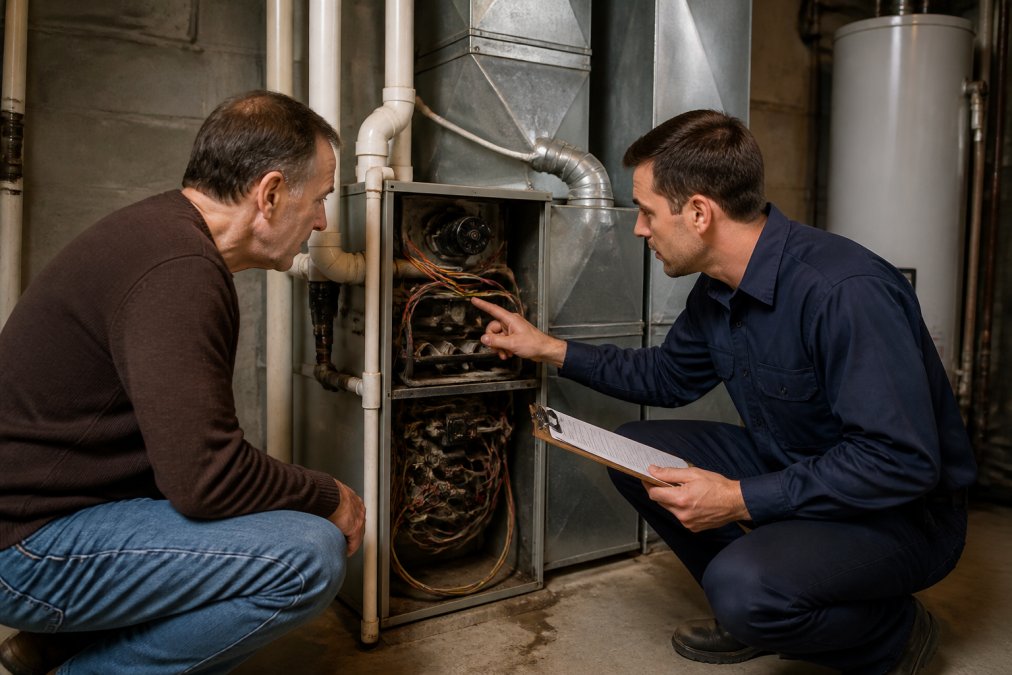
Here's how each signal reads in practice:
- Equipment age past 15 years. Most furnaces and air conditioners are designed for 15-20 years of service life.
- Breakdown frequency. Two or more service calls in a single year signals a system in decline.
- Rising utility bills. Climbing energy consumption without a rate increase means the system is losing efficiency.
- Uneven comfort. Rooms that never reach temperature often indicate a failing compressor or a system that's lost capacity.
- Strange noises. Grinding, banging, or rattling points to component failure in progress.
- Refrigerant leaks. Older systems using discontinued refrigerant blends face rising recharge costs.
- Parts scarcity. When a technician struggles to source a component, future repairs get slower and pricier.
HVAC System Lifespan: How Long Should Your Unit Last?
Your HVAC system lifespan depends on equipment type, maintenance history, and installation quality. Furnaces typically last 15-20 years, air conditioners 10-15 years, and heat pumps roughly 15 years with regular service.
Ask for the commissioning report when your system is installed. It documents static pressure, refrigerant charge, and airflow readings. If a contractor won't provide one, the installation quality is a question mark.
Long-Term ROI, Financing, and Tax Incentives
Replacement math changes once you factor in what a new system saves over time. A high-efficiency unit lowers monthly energy consumption, and those savings compound across the system's lifespan. That's the long-term ROI most guides never actually calculate, they stop at the 50% rule and call it a day.
The ROI formula, spelled out.
- Annual energy savings: Compare your current utility spend to projected consumption on a higher-SEER or higher-AFUE system. Your contractor can model this from your home's square footage, insulation, and climate zone.
- Avoided repair costs: Add the repairs you would likely face over the next 3-5 years on the old unit, based on your own service history.
- Incentive value: Subtract any applicable federal tax credit and utility rebate from the net cost.
- Financing cost: Add interest if you finance the purchase.
Financing options. Three common paths:
- Manufacturer or contractor financing: Often 0% APR for a promotional period, then a standard rate. Read the terms, deferred-interest offers can retroactively charge interest if you don't pay off the balance in time.
- Home equity loan or HELOC: Usually the lowest rate for homeowners with equity, and the interest may be tax-deductible if funds are used to improve the home.
- Utility on-bill financing: Some utilities let you repay efficiency upgrades through your monthly bill, which avoids a credit check.
Ask your contractor for the AHRI certificate number for the exact equipment being quoted. You need it to claim most federal credits and utility rebates, and it confirms the equipment actually meets the efficiency threshold the program requires.
Maintenance History and Smart Home Integration
A documented maintenance history is your strongest negotiating tool, whether you repair or replace. Systems on annual service plans show fewer unexpected breakdowns and lower long-term repair costs, based on case work from KCA Services and Peterson Service. Both documented clients who moved from reactive repairs to structured maintenance programs and saw downtime and long-term costs drop.
Maintenance records do two things: they extend your current system's life, and they give any future buyer or technician a clear picture of how the equipment has been treated. Both have real dollar value.
Frequently Asked Questions
What is the $5,000 rule in HVAC?
The $5,000 rule multiplies your system's age by the repair cost. If the result exceeds $5,000, replacement is usually the better financial decision. For example, a 12-year-old system with a $450 repair gives 12 x 450 = $5,400, which crosses the threshold. This guideline, cited by Lennox in 2026, helps homeowners avoid sinking money into aging equipment that will likely need more repairs soon.
What is the average cost to replace an HVAC system?
In 2026, full HVAC system replacement typically ranges from $2,500 to $8,000, depending on system type, size, and complexity, according to WebFX. Heat pumps, furnaces, and combined systems fall at different points in that range. The average HVAC replacement cost also depends on whether ductwork modifications are needed. Get a firm written estimate before committing, since installation quality affects long-term performance as much as equipment brand.
Should I replace my 20-year-old HVAC system?
A 20-year-old system is past or near the end of its expected HVAC system lifespan, which is typically 15 to 20 years for furnaces and 12 to 15 for air conditioners. If it needs a repair costing more than 50% of a new system, replacement is the sounder investment under the 50% rule. Rising utility bills, frequent breakdowns, and unavailable parts also point toward replacement.
Does a new HVAC system increase home value?
A new HVAC system can increase home value by improving energy efficiency and reducing utility bills, which appeals to buyers. It also removes the risk of an imminent failure that would show up in a home inspection. Beyond resale, a modern system with a higher SEER rating lowers monthly energy consumption, so the cost-effectiveness plays out over years of ownership, not just at sale.