

Table of Contents
- Why West Michigan Homes Face Higher Freeze Risk
- What Temperature Do Pipes Freeze?
- How to Winterize Outdoor Faucets and Hose Bibs
- Should I Drip Faucets to Prevent Freezing?
- How to Thaw Frozen Pipes Safely
- A Prioritized Home Inspection Checklist for Preventing Frozen Pipes
- Before You Leave Home: Winter Travel Checklist
- Frequently Asked Questions
Why West Michigan Homes Face Higher Freeze Risk
Preventing frozen pipes west in Michigan starts with understanding one uncomfortable fact: our homes were built for lake-effect snow, not for the wind that comes with it.
Lake-effect weather swings fast here. A mild afternoon can drop below freezing overnight, and that rapid shift is what catches plumbing off guard. Pipes in exterior walls, unheated garages, and Michigan basements sit closest to the cold and freeze first.
Older housing stock adds to the risk. Many homes in the region have plumbing routed through crawl spaces and along exterior walls, often with thin or missing insulation. Add a west-facing wall that takes direct wind, and you have a pipe that cools far faster than the thermostat suggests.
The fix is not complicated. It is a short list of cold-weather precautions done before the first hard freeze, not during it.
What Temperature Do Pipes Freeze?
Water pipes typically begin to freeze when the surrounding air holds at 20°F or below for several hours, though wind and poor insulation can push that risk higher.
The temperature inside your walls matters more than the thermostat reading. A pipe in an unheated crawl space can sit well below the outdoor reading. That is why a home set to a comfortable temperature can still freeze a line in the garage.
A hard freeze is a stretch of temperatures cold enough to freeze standing water in exposed pipes. Forecasts that call for single digits overnight deserve action the day before, not the morning of.
How to Winterize Outdoor Faucets and Hose Bibs
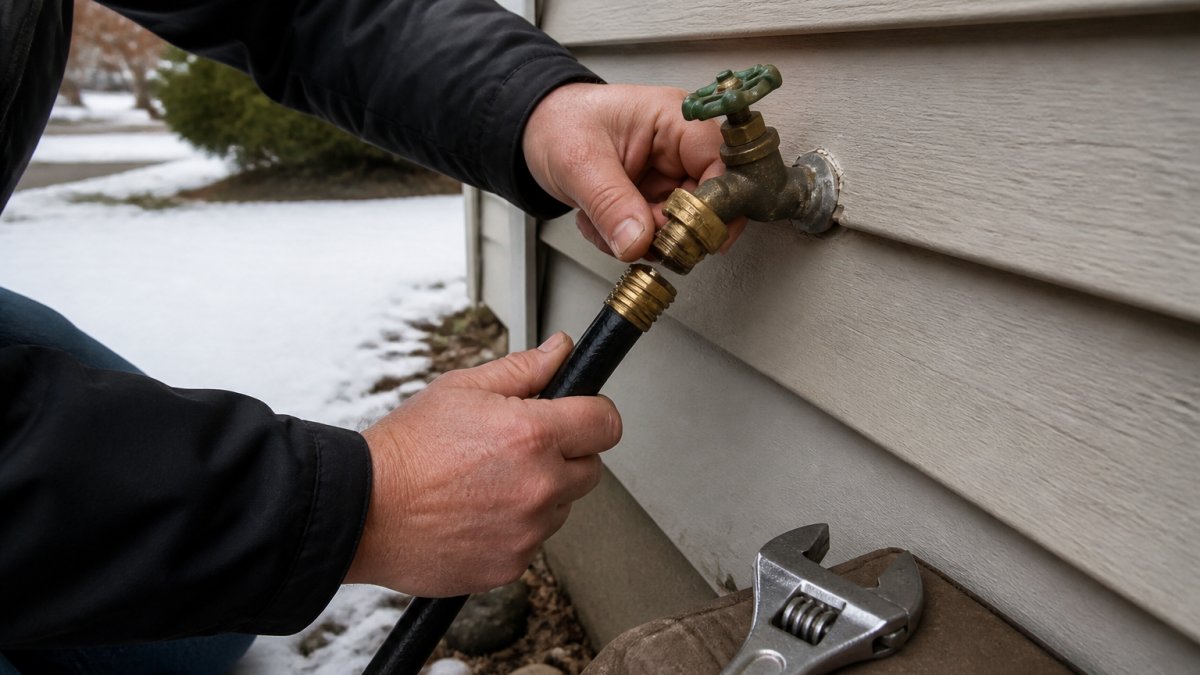
Winterizing outdoor faucets takes about fifteen minutes per spigot and prevents the most common freeze damage we see. The steps are simple, and skipping them is the single biggest mistake homeowners make.
- Disconnect every garden hose from the exterior faucet. A hose left connected traps water in the pipe.
- Drain the hose completely and store it indoors.
- If your home has one, shut off the interior valve that feeds each hose bib.
- Open the outdoor faucet to drain trapped water.
- Install an insulated cover over each hose bib.
- Check for drips or leaks before the first freeze and repair them now.
Should I Drip Faucets to Prevent Freezing?
Yes, letting a faucet drip at a slow trickle during a cold snap helps prevent freezing. Moving water freezes more slowly than still water, and the drip relieves pressure if a line does start to ice up.
Pick the faucet farthest from where water enters your home. That pulls fresh, moving water through the most vulnerable stretch of pipe. A pencil-thin stream is enough; you do not need a full flow.
Open cabinet doors under sinks on exterior walls. This lets warm air circulation reach the pipes. Keep the thermostat set consistently, day and night, at 55°F or higher.
How to Thaw Frozen Pipes Safely
Thawing a frozen pipe safely means warming it slowly, never using an open flame, and knowing when to stop and call a licensed plumber.
Step 1: Confirm the freeze before you thaw. Open the nearest faucet. No water, or a weak sputter, points to a frozen supply line. Check every fixture on that branch, a single dead faucet usually means the freeze is on that line, while multiple dead fixtures point to a main line or a shared run in a crawl space or exterior wall. Look for frost, condensation, or a slight bulge on visible pipe. Do not assume; a closed valve or a water-main outage can mimic a freeze.
Step 2: Decide whether to shut off the water. If you see a bulge, frost, or water where it should not be, shut off the main water supply before thawing. A pipe that has already split will spray once the ice melts. If the pipe looks intact and the freeze is on a visible interior run, you can usually thaw with the main valve open and the nearest faucet open to relieve pressure.
Step 3: Open the faucet and work from the faucet end back. Open the nearest faucet so melting water has somewhere to go. Apply gentle heat with a hair dryer on a low setting, a heating pad, or warm towels, starting at the faucet end and moving toward the frozen section. Working backward keeps meltwater flowing out rather than trapping it behind ice. A steady trickle tells you the ice is clearing; keep going until flow is full.
Step 4: Know the tools you must not use. Never use a space heater, blowtorch, charcoal stove, or open flame to thaw a pipe. The heat is uneven, the fire risk is real, and a torch on a concealed pipe can ignite framing inside a wall. A hair dryer on low is the safest tool most homes already own. Never pour boiling water on a pipe in an exterior wall, thermal shock can crack it.
Step 5: Stop and call for help when the pipe is hidden or stays frozen. If you cannot find the frozen section, if the pipe stays frozen after a reasonable attempt, or if the freeze is inside a wall, ceiling, or slab, stop. Hidden pipes require a licensed plumber with the right tools and the judgment to avoid a burst. The same applies if the pipe has frozen more than once in the same spot, repeat freezes usually mean an insulation or draft problem that thawing will not fix. Persistent moisture trapped within these structural cavities often leads to secondary complications, making it essential to prioritize preventing mold after damage once the plumbing integrity is restored.
A burst pipe is the outcome to avoid. If you see bulging, frost on the pipe, or water where it should not be, shut off the main water supply and call for help. Once the line is flowing again, leave the faucet open briefly to flush debris, then check the area for leaks before you close up the wall or crawl space.
A Prioritized Home Inspection Checklist for Preventing Frozen Pipes
Run this checklist before the first hard freeze each year. We order it by risk, so the most likely failure points get fixed first.
- Disconnect and drain all garden hoses
- Cover exterior faucets and hose bibs
- Insulate exposed pipes in the basement, crawl space, attic, and garage
- Seal drafts and air leaks around plumbing penetrations
- Check insulation on pipes along exterior walls
- Set the thermostat to 55°F or higher and keep it consistent
- Test that cabinet doors under exterior sinks open freely
- Locate your main water shutoff valve
|
Priority |
Area |
Action |
Why It Matters |
|---|---|---|---|
|
1 |
Hose bibs |
Disconnect hoses, add covers |
First to freeze, cheap to protect |
|
2 |
Crawl space |
Insulate exposed pipes |
Unheated and often forgotten |
|
3 |
Exterior walls |
Seal drafts, check insulation |
Wind-driven cold hits hardest |
|
4 |
Garage |
Insulate pipes above it |
Unheated space above heated rooms |
|
5 |
Thermostat |
Hold 55°F or higher |
Consistent heat protects the whole system |
Different plumbing layouts need different attention. Pipes in a Michigan basement stay warmer than pipes in a vented crawl space. If your home has both, prioritize the crawl space.
Before You Leave Home: Winter Travel Checklist
Leaving for a winter trip raises the stakes, because no one is home to catch a problem early. The right plan depends on how long you will be gone and how cold the forecast runs. Use this as a decision framework rather than a fixed list.
Set the thermostat and leave it. Set the thermostat no lower than 55°F and leave it there for the whole trip. Turning heat down to save money can cost far more if a pipe bursts. A common pattern is a homeowner who drops the setting to 45°F to save on the gas bill and comes home to a split line in an exterior wall. Keep interior doors open so warm air reaches bathrooms, closets, and rooms over the garage.
Match the water shutoff to the trip length. For a short trip, a long weekend, keeping the main valve open is usually fine if the heat stays at 55°F or higher. For an extended absence, shut off the main water supply and drain the lines by opening the lowest faucet in the house and the highest one to let air in. Draining removes the water that would expand if a line freezes. If your home has a basement, open the basement faucet first; if it has a crawl space, know where the lowest drain is before you need it.
Arrange a property check. Ask a neighbor or a hired service to check the house every few days. Give them the main shutoff location and a phone number. A leak sensor near the water heater and main line is cheap insurance and can alert you remotely, but it does not replace a person who can shut the water off.
Close the gaps before you go. Seal drafts around plumbing penetrations, disconnect garden hoses, and cover exterior faucets before you leave, not after you return. A west-facing wall that takes direct wind is the first place to check.
If you will be gone for an extended period and are unsure whether to shut off the water, a licensed plumber can walk your layout and tell you which lines drain safely and which should stay wet.
Frequently Asked Questions
How do I know if my pipes are frozen?
If you turn on a faucet and only a trickle comes out, or nothing at all, a pipe may be frozen. Other signs include frost on exposed pipes, a bulge in the pipe, or a knocking or gurgling sound when you open the tap. Check the most vulnerable spots first: exterior walls, basements, crawl spaces, and under sinks. If you suspect a frozen pipe, keep the faucet open and begin safe thawing. If you cannot locate the freeze or water does not return, call a licensed plumber.
Should I drip faucets to prevent freezing?
Yes, letting a faucet drip can help prevent frozen pipes during a hard freeze. A slow trickle keeps water moving and relieves pressure between the ice blockage and the faucet. Choose the faucet farthest from where the water enters your home, and both hot and cold lines if practical. A drip is not a substitute for proper insulation and heat, but it adds a layer of protection during extreme cold. If you are on a well, confirm your pump can handle the extra run time.
At what temperature do pipes freeze?
Water pipes typically begin to freeze when the surrounding air temperature drops to 20°F or below, though exposed pipes can freeze at higher temperatures if they are in unheated areas. The exact temperature depends on insulation, wind, and how long the cold lasts. Keep your thermostat at 55°F or higher to reduce the chance of freezing.
What should I do if my pipes freeze?
First, shut off the main water valve if you suspect a burst, and open the nearest faucet. Then apply gentle heat to the frozen section using a hair dryer, heat lamp, or wrapped towels soaked in warm water. Never use a blowtorch, charcoal stove, or open flame. Work from the faucet end toward the blockage. If you cannot find the freeze, the pipe is behind a wall, or water does not flow after 30 minutes of thawing, call a professional plumber. Lake Michigan Heating, Cooling, Plumbing handles emergency calls.