
Quick Summary
Choosing a heating contractor in Grand Rapids starts with asking every company the same questions about license number, insurance, who does the work, and written estimates. Verify the license with the state, confirm liability and workers’ compensation coverage, and compare written bids line by line before you sign.
- Ask for the license number in writing and confirm it is active through the state’s public licensing records.
- Request a current certificate of insurance showing general liability and workers’ compensation coverage.
- A licensed mechanical contractor should pull the permit in their own name, not leave it to you.
- A proper load calculation, called a Manual J calculation, measures your home’s actual heat loss for sizing.
- The biggest red flag is a one-line bid that does not separate equipment, labor, and ductwork.
Table of Contents
- Start With the Questions to Ask an HVAC Contractor
- Check Licensing, Insurance, and Heating Credentials
- Read Heating Contractor Reviews in Grand Rapids Carefully
- What a Heating System Installation Estimate Should Include
- Load Calculations, Ductwork, and Equipment Sizing
- Furnace Installation in Grand Rapids: Permits and Inspections
- Schedule Service With a Heating Contractor You Can Verify
- Frequently Asked Questions
Start With the Questions to Ask an HVAC Contractor
Choosing a heating contractor in Grand Rapids starts with the questions you ask before anyone touches your furnace. A good contractor answers them without flinching; a bad one changes the subject.
Ask every company the same questions, and write down the answers.
Here is the short list to bring to the table:
- What is your license number, and can I verify it with the state?
- Who will actually do the work, your employees or a subcontractor?
- Will you put the estimate in writing, with the scope spelled out?
- What is included in the price, and what would count as an extra?
That list is the backbone of everything below. If a heating contractor in Grand Rapids hesitates on the first question, you have your answer.
Check Licensing, Insurance, and Heating Credentials
Licensing is the first filter and the easiest to apply. A legitimate heating contractor carries a state license, liability insurance, and workers’ compensation coverage.
You can check a contractor’s license status directly with the state rather than taking a business card at face value.
Credentials also tell you who is responsible when something goes wrong.
Insurance and licensing are separate: a contractor can be licensed and still carry thin coverage.
How to Verify a Michigan Heating Contractor
Verification is a process, not a single phone call. Work through these steps before you sign:
- Get the license number in writing. Ask for the company’s license number and the name it is issued under. Compare that name to the name on the bid and the insurance certificate; mismatches are a warning.
- Check the state license lookup. Search the license number through the state’s official public licensing records and confirm the status is active and the license type covers the work being quoted.
- Confirm the license type matches the job. Ask whether the license covers the mechanical work being quoted, since heating work is often licensed separately from general building work.
- Ask for the certificate of insurance directly from the insurer or agent. It should show general liability coverage, workers’ compensation, and policy effective dates covering your project window.
Heating-Specific Credentials and Questions
Not all HVAC work is interchangeable. Furnace and boiler work involves gas piping, venting, combustion air, and clearances that cooling-only work does not. Ask questions that test heating-specific competence:
- Combustion analysis. Ask whether the contractor performs a combustion analysis at startup and provides the readings. A properly commissioned furnace is tested, not just switched on.
- Venting knowledge. Ask how they will vent the new unit, especially with a high-efficiency furnace and PVC venting. The answer should reference the manufacturer’s instructions and the mechanical code, not a rule of thumb.
- Gas line sizing. Ask whether the existing gas line is adequate for the new unit’s input rating and how they will confirm it.
- Clearance and combustion air. Ask how they will verify clearances from combustible material and that combustion air is supplied per code.
A contractor who answers with specifics is demonstrating the competence you are paying for. One who deflects to “we do it to code” without explaining the mechanism is asking you to take it on faith.
If your current furnace fails before you have chosen a replacement, our guide to emergency furnace repair in Kent County covers what to do first and how emergency repair fits into the installation decision.
Read Heating Contractor Reviews in Grand Rapids Carefully
Reviews are useful only if you read them like a skeptic. A wall of five-star ratings with no detail tells you almost nothing. Look for reviews that name the specific problem, the technician, and the outcome.
- Repeated complaints about the same thing. Late arrivals, surprise charges, or a technician who pushed a full replacement when a repair would do. One bad review is noise; five saying the same thing is a signal.
- Reviews that mention diagnosis. A good heating contractor explains what failed and why. Reviews that praise the explanation are worth more than reviews that just say “great service.”
- Responses from the company. A business that answers critical reviews calmly and offers to make it right is showing you how it behaves when something goes wrong.
Ignore the extremes and read the middle. A three-star review that explains exactly what happened often tells you more than a glowing one.
What a Heating System Installation Estimate Should Include
A heating system installation estimate should be a document, not a number shouted over a clipboard. Ask for it in writing, and check that it covers scope, equipment, labor, and exclusions.
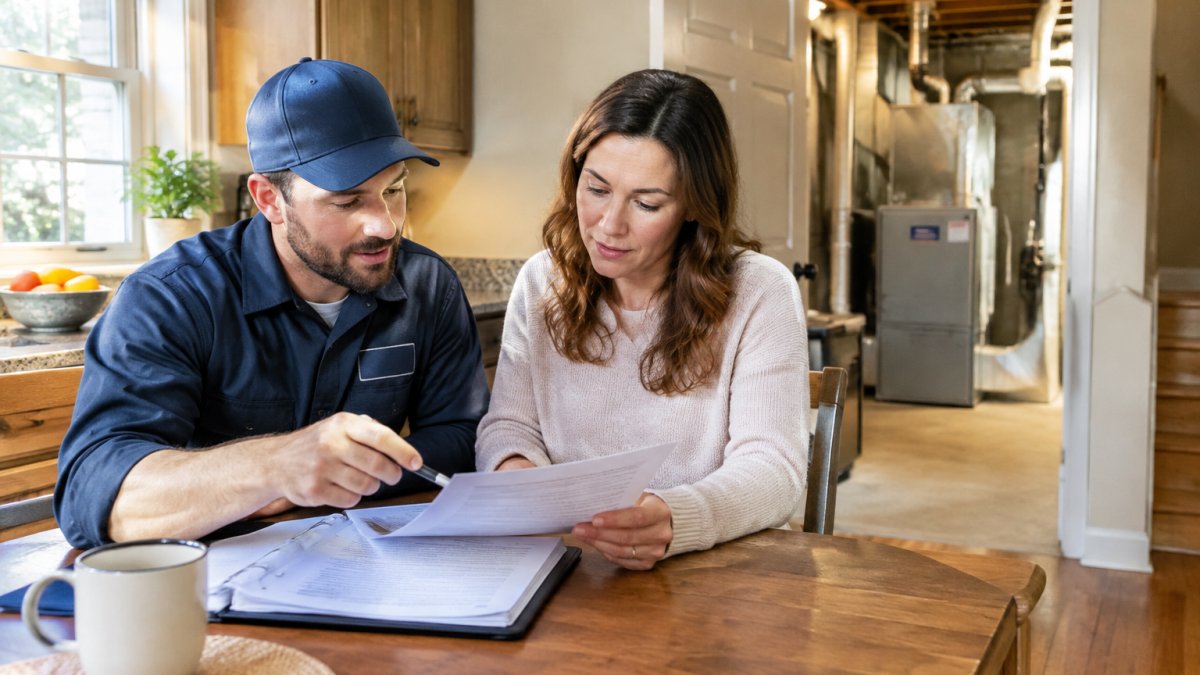
Here is what we would want to see on any written quote before signing:
|
Estimate Section |
What It Should State |
Why It Matters |
|---|---|---|
|
Equipment |
Brand, model number, efficiency rating, size in BTUs |
Lets you compare bids apples to apples |
|
Labor |
Crew size, estimated days on site, what is included |
Separates real labor from hidden extras |
|
Ductwork |
Whether modifications are included or billed separately |
A common source of surprise charges |
|
Permits |
Who pulls the permit and who pays the fee |
Unpermitted work can void coverage |
|
Removal |
Hauling away the old unit and any hazardous materials |
Often quietly excluded |
|
Warranty |
Manufacturer terms plus the contractor’s own labor warranty |
Two different promises, both matter |
|
Payment |
Deposit amount, milestones, final payment terms |
Protects you from paying in full upfront |
The biggest red flag is a one-line bid.
How to Compare Two Written Estimates Side by Side
Comparing bids is not about picking the lower total. It is about normalizing scope so you are pricing the same job. Walk down the same categories in the same order:
- Equipment match. Confirm both bids specify the same model number, efficiency rating (AFUE for furnaces), and nominal BTU output. A lower bid that swaps in a smaller or lower-efficiency unit is not a lower bid for the same work.
- Labor and crew. Check whether both assume the same number of technicians and days. A one-day quote against a two-day quote usually means one contractor is planning to skip duct sealing, commissioning, or cleanup.
- Ductwork scope. One bid may include sealing and balancing; the other may list it as an add-on. Ask each contractor to state, in writing, whether duct modifications are included and what triggers an extra charge.
- Permit responsibility. The bid should name who pulls the permit and who pays the fee. If the permit line is blank, ask before you sign.
Exclusions to Look For
Most estimate disputes come from work that was never in the bid. Read the exclusions section as carefully as the price. Common exclusions on Grand Rapids heating jobs include:
- Duct sealing, duct replacement, or adding return air
- Repairing or replacing a flue liner or chimney
- Electrical work beyond a simple disconnect and reconnect
- Gas line resizing or relocation
Ask each contractor to mark which of these are included, optional, or billed as extras with a stated rate. That one step turns a vague bid into a comparable one.
If you are weighing repair against replacement before you commit to a bid, our guide to HVAC repair vs system replacement walks through the tradeoffs so the estimate makes sense in context.
Load Calculations, Ductwork, and Equipment Sizing
Equipment sizing is where cheap bids fall apart. A contractor who sizes a furnace by eyeballing your square footage is guessing, and an oversized or undersized unit will cost you comfort and money for years.
A proper load calculation measures your home’s actual heat loss: insulation, window area, air leakage, ceiling height, and local climate.
Ductwork deserves the same scrutiny. A perfectly sized furnace pushing air through undersized or leaky ducts will not heat your house evenly.
If you are planning an addition, a finished basement, or a layout change, the load calculation needs to account for it. Our page on planning a remodel and your HVAC load explains why the math has to be redone before you buy equipment.
Furnace Installation in Grand Rapids: Permits and Inspections
Furnace installation typically requires a permit and an inspection, and the contractor should handle both.
Ask the contractor who pulls the permit. If the answer is “you can pull it yourself,” that is a warning.
Building codes govern venting, clearance from combustible material, and combustion air supply. A legitimate installer should know the applicable mechanical code well.
Watch out: unpermitted furnace work can complicate a home sale, complicate an insurance claim after a fire, and leave you responsible for correcting code violations at your own expense.
Schedule Service With a Heating Contractor You Can Verify
The final step is the easiest to skip and the most important: verify before you book. Check the license, confirm the insurance, read the estimate line by line, and make sure the contractor serves your address.
If you are in Grand Rapids and want to confirm service availability before you call, our Grand Rapids service area page shows the neighborhoods and nearby areas we cover. When you are ready to move, you can request furnace repair and get a straight answer on whether you need a repair or a replacement.
A heating contractor is someone you let into your home and trust with a system your family depends on all winter. Ask the questions, read the paperwork, and do not let a low bid talk you out of the checks that protect you.
Frequently Asked Questions
What is the $5,000 rule in HVAC?
The $5,000 rule is a rough rule of thumb some homeowners use: if a repair costs more than $5,000, or more than half the price of a new system, replacement may make more sense than fixing the old unit. It is not a standard or a code requirement, and it ignores system age, efficiency, and warranty status. Ask your heating contractor to show you the repair cost, the expected remaining life of your equipment, and a written replacement estimate so you can decide with real numbers instead of a slogan.
What should I ask a heating contractor before hiring them?
Ask for their license number and proof of insurance, whether the technicians are employees or subcontractors, and whether they will perform a room-by-room load calculation before quoting equipment. Request a written estimate that lists equipment model numbers, labor, permits, and exclusions. Ask about warranty coverage on both parts and labor, expected response time for emergencies, and whether they will pull the permit themselves. A contractor who answers these plainly and puts them in writing is easier to trust than one who deflects.
How do I compare heating contractor quotes in Grand Rapids?
Compare line by line, not by the bottom number. Check that each quote names the same equipment model and efficiency rating, includes permit fees and inspection costs, and states what is excluded, such as duct sealing or old equipment removal. A low bid often omits labor for ductwork modifications or skips the load calculation entirely. Ask each contractor to explain any gap between quotes in writing. A quote with no permit line is a warning sign.
Should a heating contractor inspect my home before recommending a new system?
Yes. A proper assessment includes measuring rooms, checking insulation and window condition, inspecting existing ductwork for leaks and sizing, and running a load calculation. Without that, a contractor is guessing at equipment size, and an oversized furnace short-cycles, wastes energy, and wears out faster. If someone quotes a replacement over the phone without visiting, treat that as a screening failure. Ask to see the load calculation results before you sign anything.
Winter in West Michigan does not wait for a convenient moment. If your furnace is struggling, our team at Lake Michigan Heating, Cooling, Plumbing is fully insured and certified, and we explain your options clearly before any work begins. Get started with Lake Michigan Heating, Cooling, Plumbing and schedule service with a team that answers your questions upfront.
